Rotary vs Flat Plate Blister Machines: Which Is Better for Pharmaceutical Production?
Introduction: The Real Difference Usually Appears After Production Starts
When comparing blister packaging machines, many buyers first focus on speed. in most cases, rotary blister machines are often positioned as “high-speed solutions,” while flat plate blister machines are described as “more stable” or “more precise.”
Technically, both statements are partially true. But in real pharmaceutical production, the difference between rotary and flat plate blister machines usually becomes clear only after continuous operation begins. This is where many production teams start noticing:
- Sealing inconsistency
- Foil tracking drift
- Cavity deformation
- Unstable feeding
- Tooling adjustment frequency
- Downtime during format changes
In practice, choosing between rotary and flat plate systems is not simply about speed. It is about:
- Product characteristics
- Packaging material behavior
- Long-term operational stability
- Downstream integration
- Maintenance strategy
- Production flexibility
From an engineering perspective, the “better” machine is usually the one that remains stable after months of continuous production — not necessarily the one with the highest theoretical output speed.
What Is a Rotary Blister Packaging Machine?
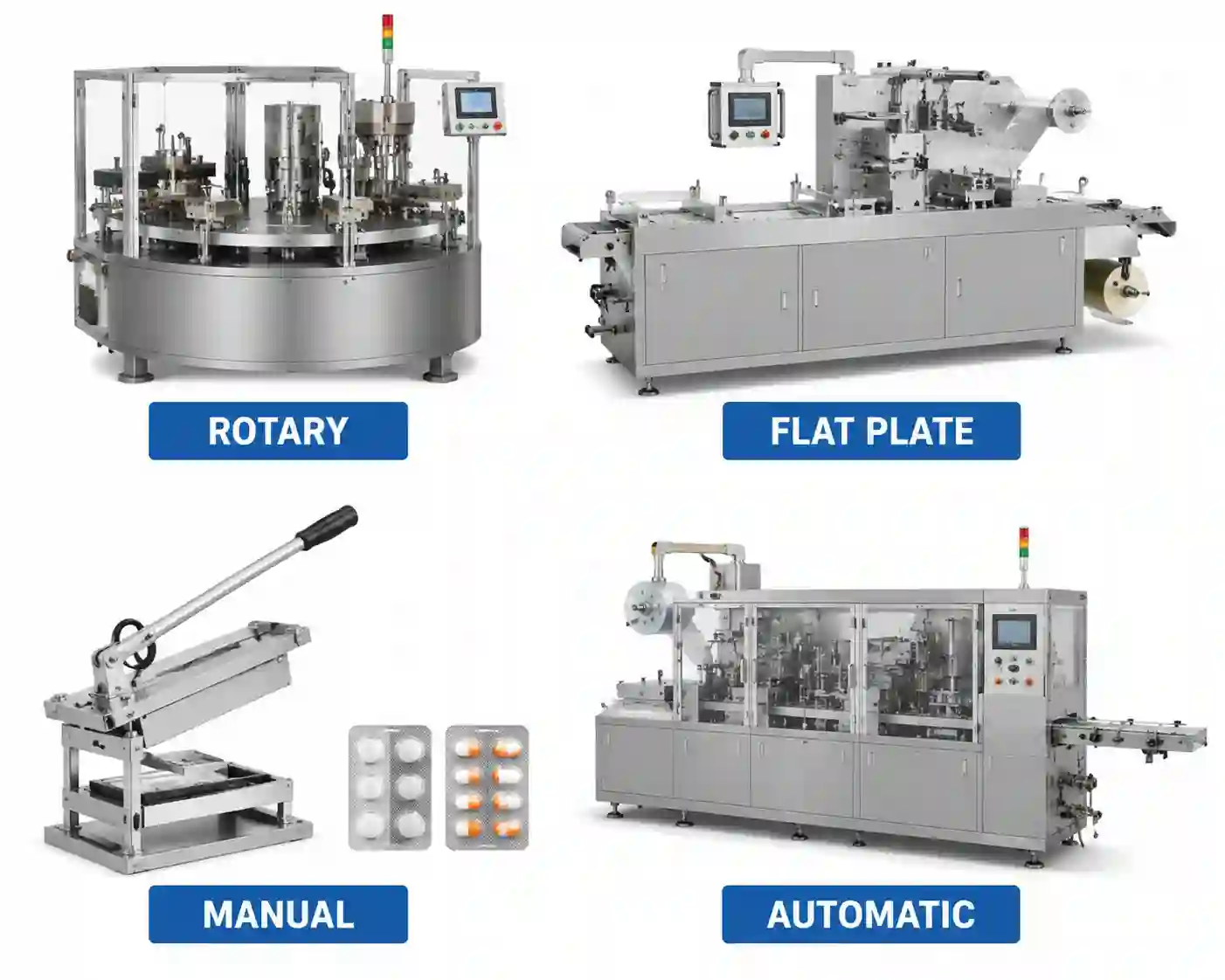
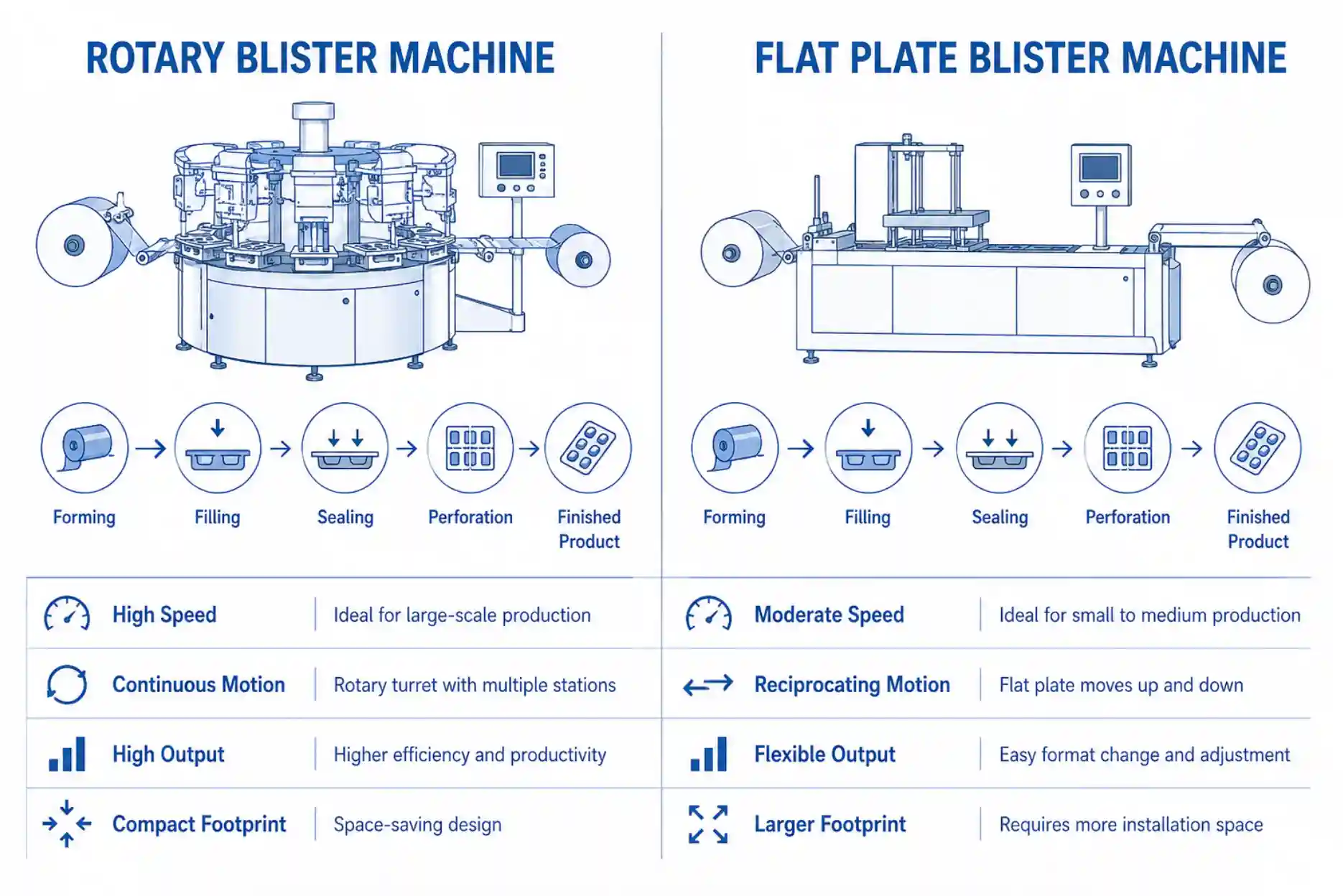
A rotary blister machine uses continuously rotating forming and sealing stations. The packaging material moves through rotating drums or rollers while forming, feeding, sealing, and cutting occur in a continuous motion. This structure is commonly used in:
- High-volume pharmaceutical production
- Large tablet packaging lines
- Continuous capsule packaging operations
Why Rotary Machines Are Popular
The biggest advantage of rotary systems is production continuity. Because the process is continuous rather than intermittent:
- Vibration can be reduced
- Throughput can increase
- Material transfer becomes smoother at high speeds
In long production runs, rotary systems are often preferred for stable high-output manufacturing. Especially in large pharmaceutical factories running multiple shifts, rotary systems usually perform better under sustained production loads.
What Is a Flat Plate Blister Machine?
Flat plate blister machines operate using intermittent motion. The film advances step-by-step through forming, feeding, sealing, cutting instead of continuous rotation.
This design is widely used for:
- Medium-speed pharmaceutical production
- Specialty products
- Complex blister shapes
- Products requiring higher sealing precision
Why Many Engineers Still Prefer Flat Plate Systems
Although flat plate machines are generally slower, they often provide:stronger sealing pressure, better cavity definition, improved forming precision, more stable handling of difficult materials.
This becomes especially important when packaging: irregular tablets, large capsules, moisture-sensitive products, Alu-Alu blister packaging, In many pharmaceutical projects involving complex cavity shapes, flat plate systems tend to maintain forming consistency more effectively during long-term operation.
Rotary vs Flat Plate: The Real Differences in Production
1. Production Speed
Rotary blister machines usually support higher continuous production speeds. This is one reason they are widely used in large pharmaceutical packaging lines. However, speed alone does not determine production efficiency. At higher speeds, production becomes more sensitive to:feeding accuracy, foil tension, heat distribution, servo synchronization, tooling repeatability, In some projects, increasing speed too aggressively actually increases reject rates and downtime. This is one reason why experienced engineers often evaluate “stable output” rather than theoretical maximum speed.
2. Sealing Stability
This is one of the biggest real-world differences. Flat plate blister machines usually apply sealing pressure more directly and uniformly. As a result, they are often preferred for:
- Alu-Alu blister packaging
- pharmaceutical products with strict barrier requirements
- products sensitive to moisture or oxygen
Rotary systems can also achieve stable sealing, but maintaining sealing consistency at higher speeds requires more precise control of: temperature, pressure, dwell time, material tension.
Many sealing problems do not appear during initial FAT testing.They often emerge later during continuous multi-shift production.
Why Blister Sealing Fails in Pharmaceutical Production
3. Material Compatibility
Packaging material behavior significantly affects blister machine selection. Different materials respond differently during forming, feeding, sealing, and cutting.
In real pharmaceutical production, material compatibility often influences:forming stability, sealing consistency, foil handling behavior, tooling wear, long-term operational stability. This becomes especially important in high-speed pharmaceutical blister packaging lines and Alu-Alu applications.
| Packaging Material | Common Machine Preference | Production Characteristics | Engineering Considerations |
|---|---|---|---|
| PVC | Rotary or Flat Plate | Easy thermoforming, widely used in pharmaceutical packaging | Generally stable during high-speed production |
| PVDC-Coated PVC | Rotary or Flat Plate | Improved moisture barrier performance | Requires more stable heat and sealing control |
| Alu-PVC | Rotary or Flat Plate | Common balance between visibility and barrier protection | Foil tension and sealing consistency become more critical during continuous production |
| Alu-Alu | Flat Plate Preferred | Cold-forming structure with high barrier protection | Requires stronger forming pressure, better cavity repeatability, and more stable material handling |
In many Alu-Alu blister packaging projects, the long-term challenge is not initial forming itself, but maintaining stable cavity consistency after continuous multi-shift production begins.
Related reading: Blister Packaging Materials Explained
4. Tooling and Changeover
This is one of the most overlooked purchasing factors.In factories running multiple SKUs, changeover efficiency directly affects production uptime.
Rotary systems often require:
- More complex tooling alignment
- Tighter synchronization
- More precise adjustments
Flat plate systems are usually simpler during format switching. In nutraceutical and contract manufacturing environments, changeover downtime often creates larger production losses than machine speed differences themselves.
5. Maintenance and Long-Term Stability
Rotary systems contain more continuously moving mechanical components.This can increase:maintenance complexity, synchronization sensitivity, long-term wear management requirements.
Flat plate systems are mechanically simpler in some configurations.However, intermittent motion may create higher mechanical impact stress over time depending on machine design.
In practice, long-term stability depends more on: machine build quality, preventive maintenance, operator training, spare parts consistency than on machine type alone.
Which Machine Is Better for Pharmaceutical Production?
The answer depends heavily on the actual production environment, packaging material, and operational priorities. In practice, experienced pharmaceutical manufacturers usually evaluate machine selection based on long-term production stability rather than theoretical output speed alone.
| Production Requirement | Rotary Blister Machine | Flat Plate Blister Machine |
|---|---|---|
| Large-volume pharmaceutical production | Highly suitable | Less commonly preferred |
| Continuous multi-shift operation | Strong long-run production capability | Suitable for medium-speed production |
| High-speed tablet packaging | Commonly preferred | Possible, but usually lower throughput |
| Integrated automatic packaging lines | Widely used | Possible depending on line design |
| Alu-Alu blister packaging | Possible with proper configuration | Often preferred |
| Difficult forming applications | More sensitive at higher speeds | Usually provides better forming control |
| Complex cavity structures | Possible but requires precise tooling | Often more stable for deep or complex cavities |
| Higher sealing precision requirements | Requires tighter process control | Often preferred for stronger sealing consistency |
| Flexible multi-SKU production | More complex tooling adjustments | Usually simpler during changeovers |
In many pharmaceutical factories, the final decision is usually based on balancing: production speed, sealing reliability, product sensitivity, material behavior, tooling flexibility, long-term operational stability—not simply theoretical output numbers.
FAQ
Q1:Is a rotary blister machine always faster?
A:Generally yes in continuous production environments, but higher speed also increases sensitivity to alignment and synchronization issues.
Q2:Why are flat plate blister machines often used for Alu-Alu packaging?
A:Because intermittent forming usually provides stronger and more controlled forming pressure for cold-forming materials.
Q3:Which machine is better for pharmaceutical sealing quality?
A:Flat plate systems are often preferred for high-barrier pharmaceutical packaging, although sealing performance also depends heavily on material compatibility and process control.
Q4:Which machine is easier to maintain?
A:This depends on machine design and build quality, but flat plate systems are sometimes mechanically simpler during troubleshooting and format changes.