Tablet vs Capsule Blister Packaging Guide
Tablets are usually easier to stabilize during high-speed production In pharmaceutical blister packaging vertical, Capsules can also run efficiently, but they typically require more careful feeding control and tighter tooling adjustment.
You can tell the minor differences at first. In real production, it can directly affect: downtime, feeding stability, rejection rates, packaging consistency,line efficiency.
This is why pharmaceutical manufacturers often evaluate tablet and capsule blister packaging differently, even when using the same blister machine platform.
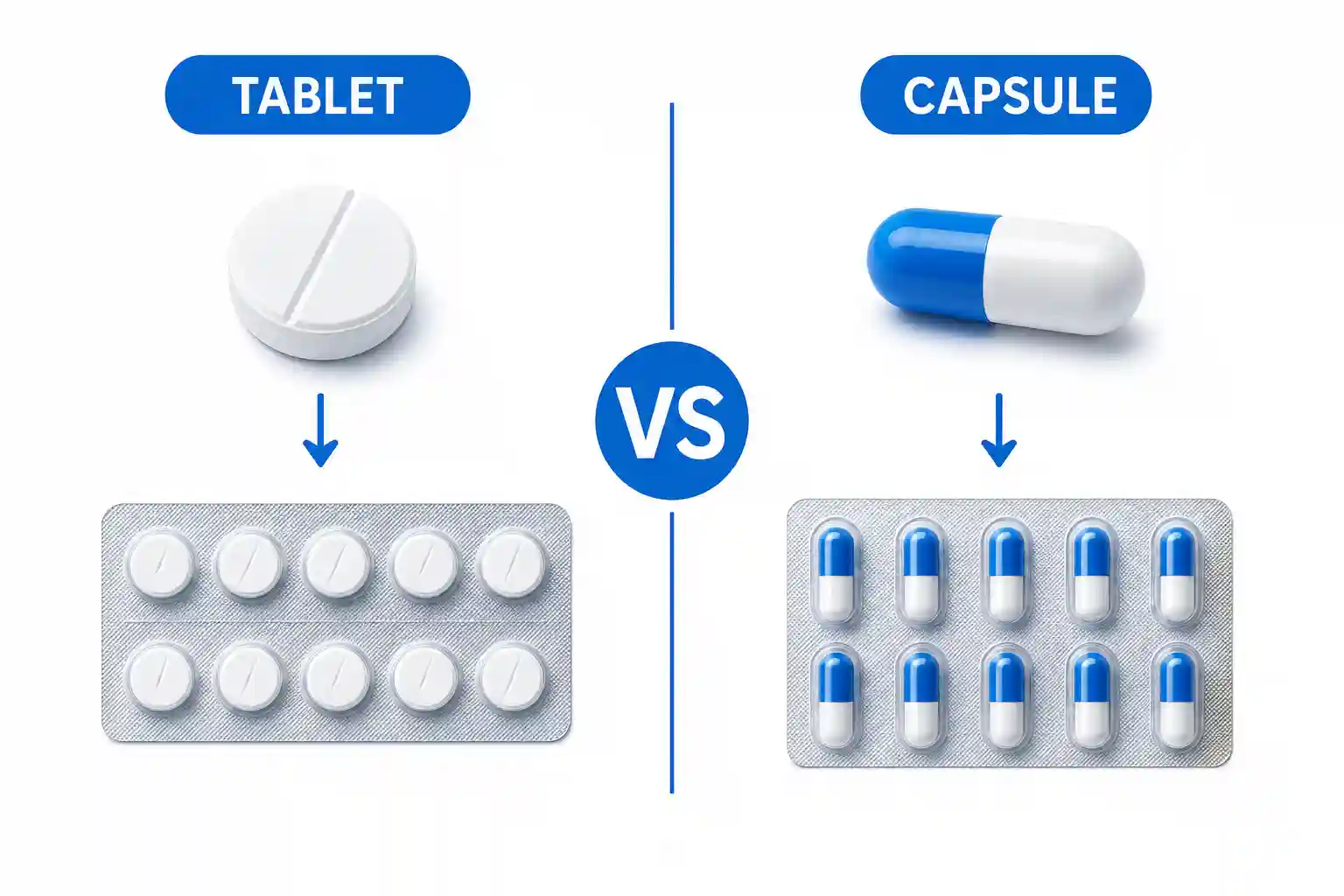
Quick Comparison: Tablet vs Capsule Blister Packaging
| Aspect | Tablets | Capsules |
|---|---|---|
| Feeding behavior | More stable and predictable | More sensitive, may rotate or misalign |
| Vibration response | Less affected | More affected by vibration settings |
| Cavity entry | Easier and more consistent | Requires more precise alignment |
| High-speed stability | Easier to stabilize | Requires tighter process control |
| Transfer sensitivity | Lower | Higher |
| Common production issue | Tablet edge chipping | Feeding interruption or misalignment |
For most blister packaging engineers, the biggest challenge with capsules is not maximum speed — it is maintaining stable feeding during long production runs.
Why Are Capsules Harder to Feed on Blister Packaging Lines?
Capsules are generally lighter and less rigid than compressed tablets. During vibration feeding, they may rotate inside the feeding channel, shift before cavity entry and respond more strongly to vibration changes
Once feeding becomes unstable, capsule lines are more likely to experience inconsistent cavity filling, transfer interruption and increased rejection
This is especially common in:
- High-speed production
- Multi-cavity tooling
- Older blister packaging lines
Tablets are usually easier to control because they move more consistently during transfer.
Does Capsule Packaging Require Different Machine Setup?
Usually yes. The machine platform itself is often the same, but capsule production normally requires more attention to tooling precision, feeder adjustment, cavity alignment, transfer timing.
| Setup Area | Tablet Packaging | Capsule Packaging |
|---|---|---|
| Feeding adjustment | Simpler | More sensitive |
| Tooling tolerance | More forgiving | Requires tighter matching |
| Transfer stability | Easier to maintain | Needs closer monitoring |
| Production setup time | Usually shorter | May require more tuning |
In many pharmaceutical factories, capsule packaging performance depends more on process setup than machine speed alone.
Do Capsules Need Better Blister Packaging Protection?
Often yes. Some capsule formulations are more sensitive to humidity, oxygen exposure and environmental fluctuation.
For this reason, manufacturers may choose below kind packaging for products requiring stronger protection.
- PVDC blister structures
- Cold-form Alu-Alu packaging
- Other high-barrier materials
However, the final material decision is usually based on: stability testing, shelf-life targets and transportation conditions, not simply whether the product is a capsule or tablet.
Which Product Is Better for High-Speed Blister Packaging?
In most production environments, tablets are easier to run at stable high speed. Their rigidity and dimensional stability make feeding more predictable. Capsules can still achieve stable high-speed production, but success depends heavily on:
- Proper feeding adjustment
- Accurate cavity dimensions
- Stable transfer synchronization
When capsule lines become unstable, experienced engineers usually check: feeding setup, tooling condition and product dimensional consistency before increasing machine speed.
Is Capsule Blister Packaging More Expensive?
It can be. Possible reasons include: higher-barrier packaging materials, more sensitive process setup, additional feeding adjustment, lower stable operating speed in some cases.
| Factor | Possible Impact on Packaging Cost |
|---|---|
| High-barrier materials | May increase material cost |
| Feeding sensitivity | May reduce stable operating speed |
| Tooling precision | May increase setup complexity |
| Product protection requirements | May require additional packaging control |
However, actual packaging cost depends on: product formulation, packaging material structure, production scale, line stability.
There is no fixed cost difference that applies to every pharmaceutical project.
Common Production Problems in Tablet and Capsule Packaging
Tablet Packaging Problems
- Tablet edge damage
- Powder generation
- Overlapping products
- Sealing inconsistency
Capsule Packaging Problems
- Unstable orientation
- Feeding interruption
- Cavity mismatch
- Shell scratches
- Transfer instability
Most of these are process-related issues rather than machine failures. This is why pharmaceutical packaging projects often require production testing before final tooling confirmation.
Can One Blister Packaging Machine Handle Both Tablets and Capsules?
Yes. Most modern pharmaceutical blister packaging machines can package both products. The key difference is whether the line can be properly adjusted for:
- Feeding behavior
- Tooling configuration
- Cavity dimensions
- Transfer conditions
For multi-product pharmaceutical factories, setup flexibility is often more important than maximum output speed.
Engineering Insight: Most Blister Packaging Problems Start Before Production
In many pharmaceutical projects, the machine itself is not the main problem. Most long-term production issues come from: poor tooling matching, unstable feeding conditions, incorrect cavity design, unsuitable packaging material selection. This is especially true for capsule blister packaging.
Factories that validate feeding behavior and tooling setup early usually experience:
- Fewer production interruptions
- More stable output
- Lower rejection rates
- Smoother scale-up later
FAQ
Q1: Are capsules always harder to blister pack?
A: Not always, but they are generally more sensitive during feeding and transfer than standard tablets.
Q2: Can tablets and capsules use the same blister packaging machine?
A: Yes. Most pharmaceutical blister machines support both with proper tooling and setup adjustment.
Q3: Why is Alu-Alu packaging used for some capsules?
A: Alu-Alu structures provide stronger moisture and oxygen protection for sensitive products.
Q4: Does higher packaging speed always improve efficiency?
A: No. Unstable high-speed production may increase:
- Downtime
- Rejection
- Sealing defects
Stable continuous production is usually more important than peak speed.