Quick Answer: Rotary vs Linear Labeling Machine
For pharmaceutical bottle labeling applications, rotary labeling machines are generally suitable for high-volume production lines requiring high-speed and consistent labeling accuracy, while linear labeling machines are better suited for manufacturers handling multiple bottle formats, frequent changeovers, and flexible production requirements.
The right choice depends on five key factors:
- Production volume
- Bottle specifications
- Label material and accuracy requirements
- Product changeover frequency
- Future production expansion plans
Choosing the correct labeling technology before purchase can help reduce production downtime, labeling failures, and long-term operating costs.
Why Choosing the Right Bottle Labeling Machine Matters
In pharmaceutical packaging, labeling is not simply a final packaging step. It directly affects product identification, traceability, compliance, and production efficiency.
Many buyers focus mainly on machine speed when evaluating suppliers. However, actual production performance depends on a combination of factors, including bottle handling stability, label compatibility, changeover efficiency, and after-sales support.
Therefore, the best labeling machine is not always the fastest machine — it is the one that matches your production requirements.
Rotary vs Linear Bottle Labeling Machines: Working Principle
Rotary Bottle Labeling Machine
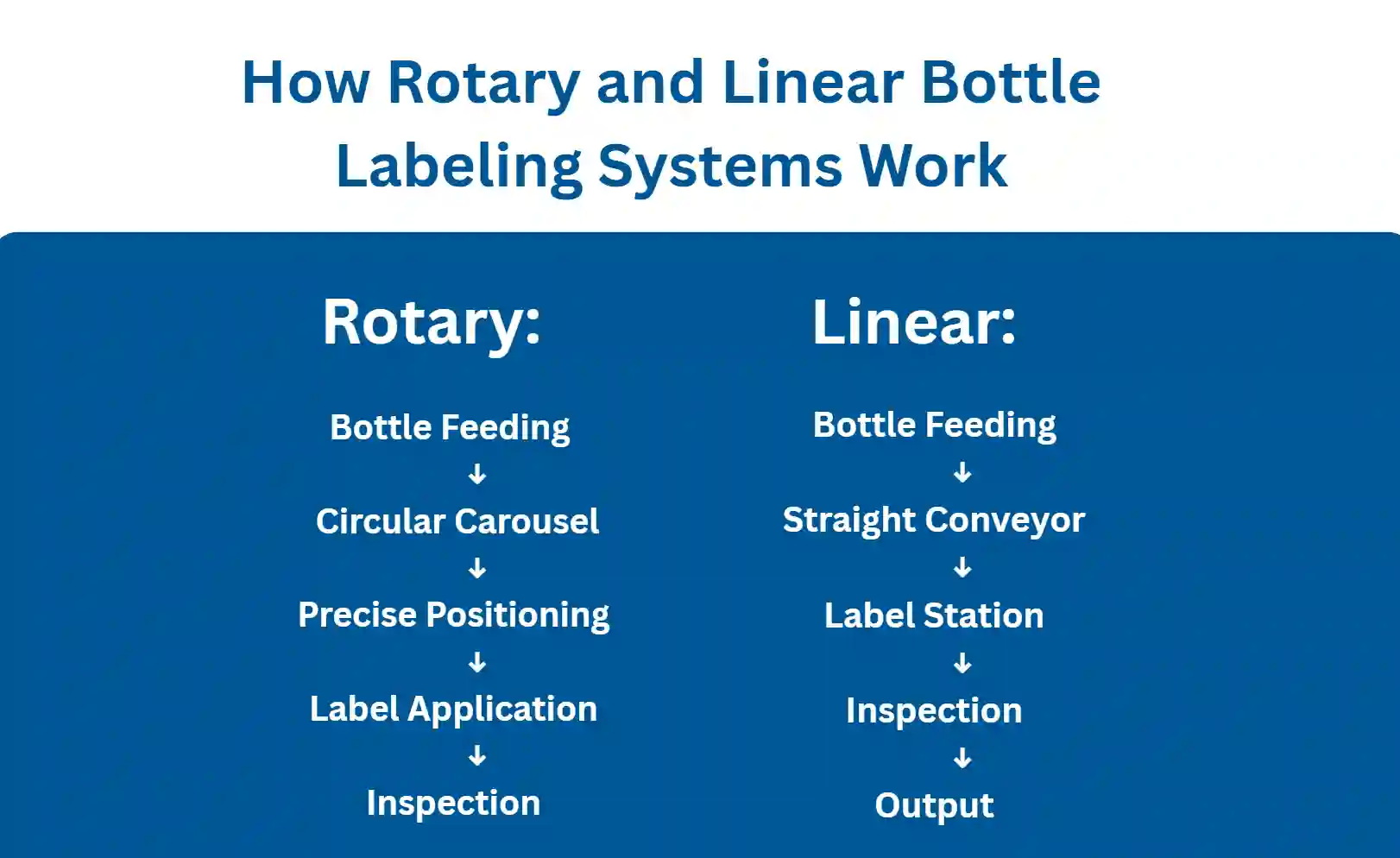
A rotary labeling machine uses a rotating carousel or indexing system to position bottles accurately during the labeling process.
The bottle moves through multiple stations where it is:
- Fed into the machine
- Positioned precisely
- Labeled during rotary movement
- Inspected and discharged
Typical Advantages
- High-speed continuous operation
- Excellent labeling accuracy
- Stable bottle positioning
- Suitable for large-scale production
Common Applications
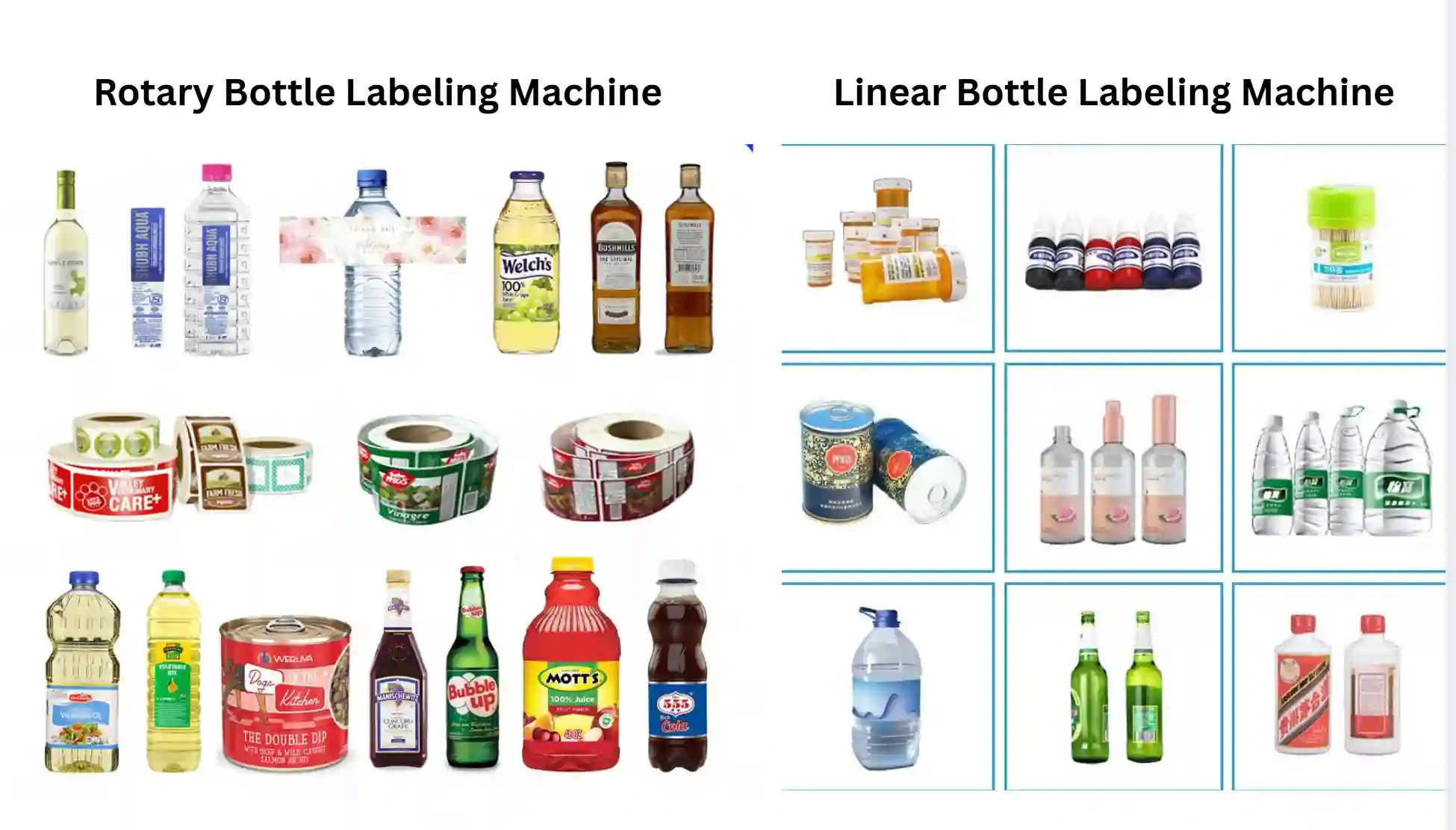
- Pharmaceutical bottles
- Vials
- Injection containers
- High-volume production lines
Linear Bottle Labeling Machine
A linear labeling machine transports bottles through a straight conveyor system and applies labels at fixed stations.
The production process is usually more flexible for different bottle sizes and product variations.
Typical Advantages
- Flexible product changeover
- Easier adjustment for multiple formats
- Lower initial investment
- Suitable for medium-speed production
Common Applications
- Multiple SKU pharmaceutical production
- Contract manufacturing facilities
- Small and medium batch production
Rotary vs Linear Labeling Machine Comparison
| Evaluation Factor | Rotary Labeling Machine | Linear Labeling Machine |
|---|---|---|
| Production speed | Designed for high-speed continuous production | Suitable for medium-speed applications |
| Bottle positioning | High precision through rotary positioning | Stable with proper bottle handling |
| Production flexibility | Better for dedicated products | Better for multiple product formats |
| Changeover frequency | Less suitable for frequent changes | More suitable for frequent changeovers |
| Floor space | Compact for high output | Requires longer conveyor layout |
| Investment level | Higher initial investment | More economical entry option |
| Best fit | Large pharmaceutical production lines | Flexible pharmaceutical production |
How Engineers Select the Right Labeling Machine
Instead of asking:
“Which machine is better?”
Experienced engineers usually evaluate:
“Which machine creates the lowest production risk for our application?”
The selection decision is usually based on five factors.
1. Production Volume Requirement
| Production Situation | Recommended Choice |
|---|---|
| Continuous high-volume production | Rotary labeling machine |
| Medium production volume | Linear labeling machine |
| Multiple small batches | Linear labeling machine |
A high-speed machine may not provide better results if production changes frequently or bottle formats are unstable.
2. 
Before selecting equipment, suppliers should evaluate:
| Bottle Factor | Why It Matters |
|---|---|
| Bottle material | Affects label adhesion performance |
| Bottle diameter | Determines positioning system requirements |
| Bottle height | Influences labeling accuracy |
| Bottle shape | Determines handling method |
| Surface condition | Affects label application stability |
Different bottle designs may require different feeding, positioning, and labeling solutions.
3. Label Material and Application Requirements
Label performance depends not only on the machine but also on label structure.
| Label Type | Possible Challenge |
|---|---|
| Paper label | Edge lifting or poor adhesion |
| Transparent label | Bubble and positioning issues |
| Film label | Static and wrinkle control |
| Small-size label | Higher accuracy requirements |
A reliable supplier should verify label compatibility before mass production.
4. Performance Validation Before Purchase
A professional purchasing process should include application testing.
Recommended Factory Acceptance Testing (FAT)
Before placing an order, buyers should confirm:
| Testing Item | Purpose |
|---|---|
| Bottle sample test | Verify handling compatibility |
| Label sample test | Confirm adhesion and accuracy |
| Speed test | Validate actual production output |
| Long-running test | Check stability during continuous operation |
| Changeover test | Evaluate flexibility |
This step helps avoid purchasing a machine that performs well in specifications but fails in real production.
5. Future Production Expansion
A labeling machine should support not only today's requirements but also future production changes.
Consider:
- New bottle sizes
- Additional product lines
- Increased production volume
- More labeling requirements
- Integration with inspection systems
Selecting equipment only based on current demand may create limitations later.
Recommended Labeling Solutions by Production Scenario
| Production Scenario | Recommended Solution | Reason |
|---|---|---|
| Large pharmaceutical manufacturer | Rotary labeling machine | Maximum efficiency for continuous production |
| High-volume single product | Rotary system | Stable and consistent output |
| Multiple pharmaceutical SKUs | Linear labeling machine | Easier format adjustment |
| Contract manufacturing (CMO/CDMO) | Flexible linear system | Supports frequent product changes |
| Growing production line | Modular labeling solution | Allows future upgrades |
How to Evaluate a Pharmaceutical Labeling Machine Supplier
Machine performance depends not only on equipment design but also on supplier capability.
Before purchasing, evaluate:
| Supplier Capability | Why It Matters |
|---|---|
| Application testing support | Confirms machine suitability |
| Pharmaceutical project experience | Reduces implementation risk |
| Custom engineering ability | Handles special bottle requirements |
| Spare parts availability | Ensures long-term operation |
| Technical support | Reduces downtime after installation |
A reliable supplier should provide engineering support before, during, and after installation.
Common Purchasing Mistakes When Buying Bottle Labeling Machines
Mistake 1: Choosing Only Based on Maximum Speed
A machine’s catalogue speed does not always represent actual production output.
Real performance depends on:
- Bottle stability
- Label material
- Operator efficiency
- Upstream and downstream equipment coordination
Mistake 2: Skipping Sample Testing
Different bottles and labels can significantly affect labeling performance.
Testing real samples before purchase reduces unexpected production issues.
Mistake 3: Ignoring Future Requirements
A machine that works today may become inefficient when production expands.
Consider future product changes before making the final decision.
FAQ
Is rotary labeling machine better than linear labeling machine?
Neither technology is universally better. Rotary labeling machines are generally preferred for high-volume pharmaceutical production, while linear machines provide better flexibility for multiple products and frequent changeovers.
Which labeling machine is suitable for pharmaceutical bottles?
The suitable machine depends on bottle type, production speed, labeling accuracy requirements, and product changeover frequency.
What should I test before purchasing a bottle labeling machine?
Buyers should test bottle compatibility, label adhesion, labeling accuracy, production speed, and long-term running stability.
How can I choose a reliable labeling machine supplier?
Evaluate the supplier’s engineering capability, application testing process, pharmaceutical experience, spare parts support, and after-sales service.
Can one labeling machine handle different bottle sizes?
Some systems can support multiple bottle formats, but the actual flexibility depends on machine design, changeover system, and bottle handling configuration.
Need Help Selecting the Right Pharmaceutical Bottle Labeling Solution
Choosing between rotary and linear labeling technology requires a clear understanding of your bottle specifications, production requirements, and future expansion plans.
Our engineering team can help evaluate your application requirements and recommend a suitable labeling solution based on your production conditions.