Types of Blister Packaging Machines: Rotary, Flat Plate, Manual & Automatic
Introduction: Picking the Right Blister Machine Goes Beyond Specs
When produce tablets/pills or capsules, selecting a blister packaging machine is a decision that directly impacts throughput, product quality, and downstream packaging efficiency. Even a high-end machine can underperform if it doesn’t match your product, line layout, or operational conditions. it has direct effect on the revenue and cost ratio of your business,
We’ll introduce the four main blistering machine types — rotary, flat plate, manual, and automatic — highlighting how each behaves in real production, and analysis what engineers need to know and how to choose identify the cons and pros.
1. Rotary Blister Machines – High-Speed Workhorses
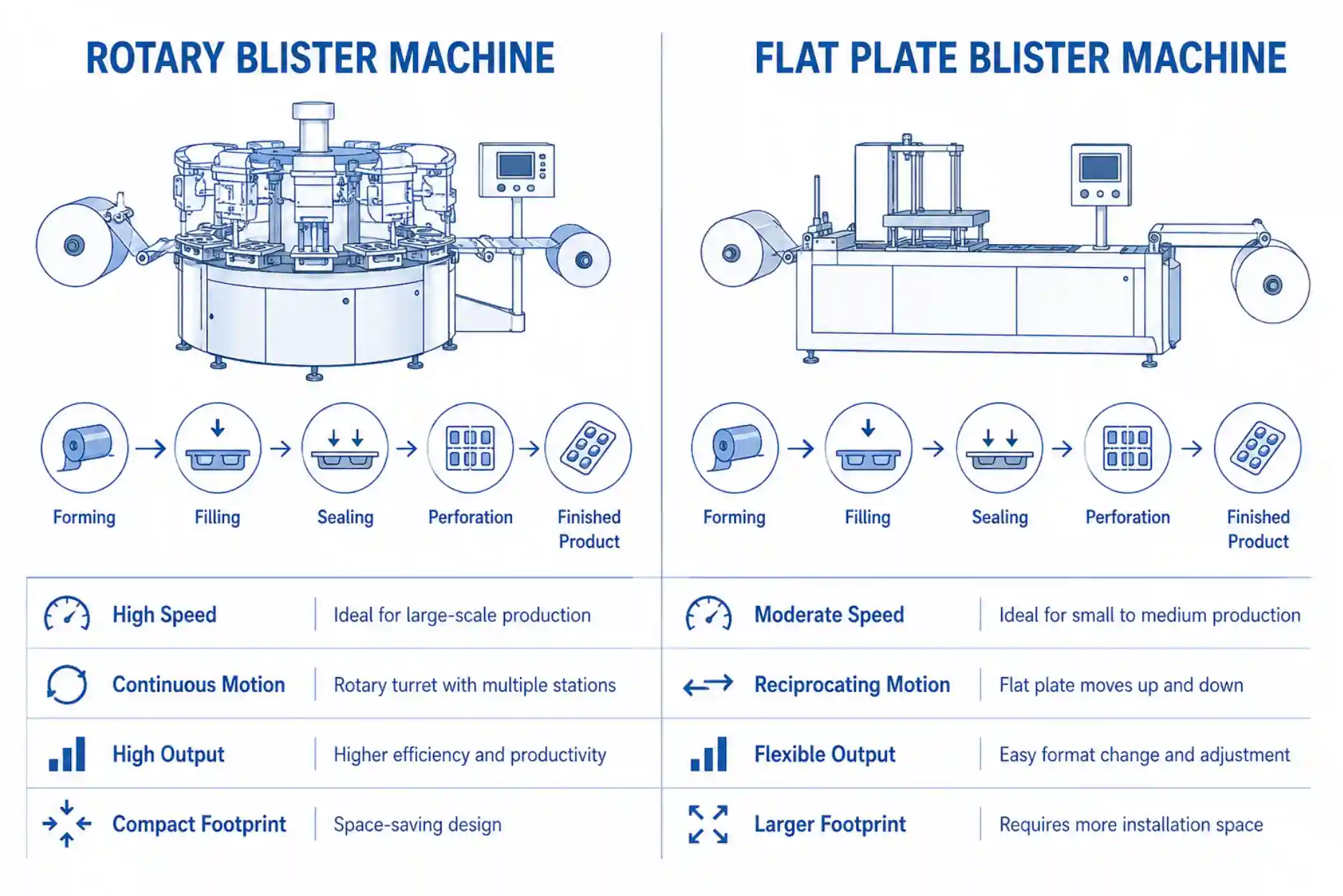
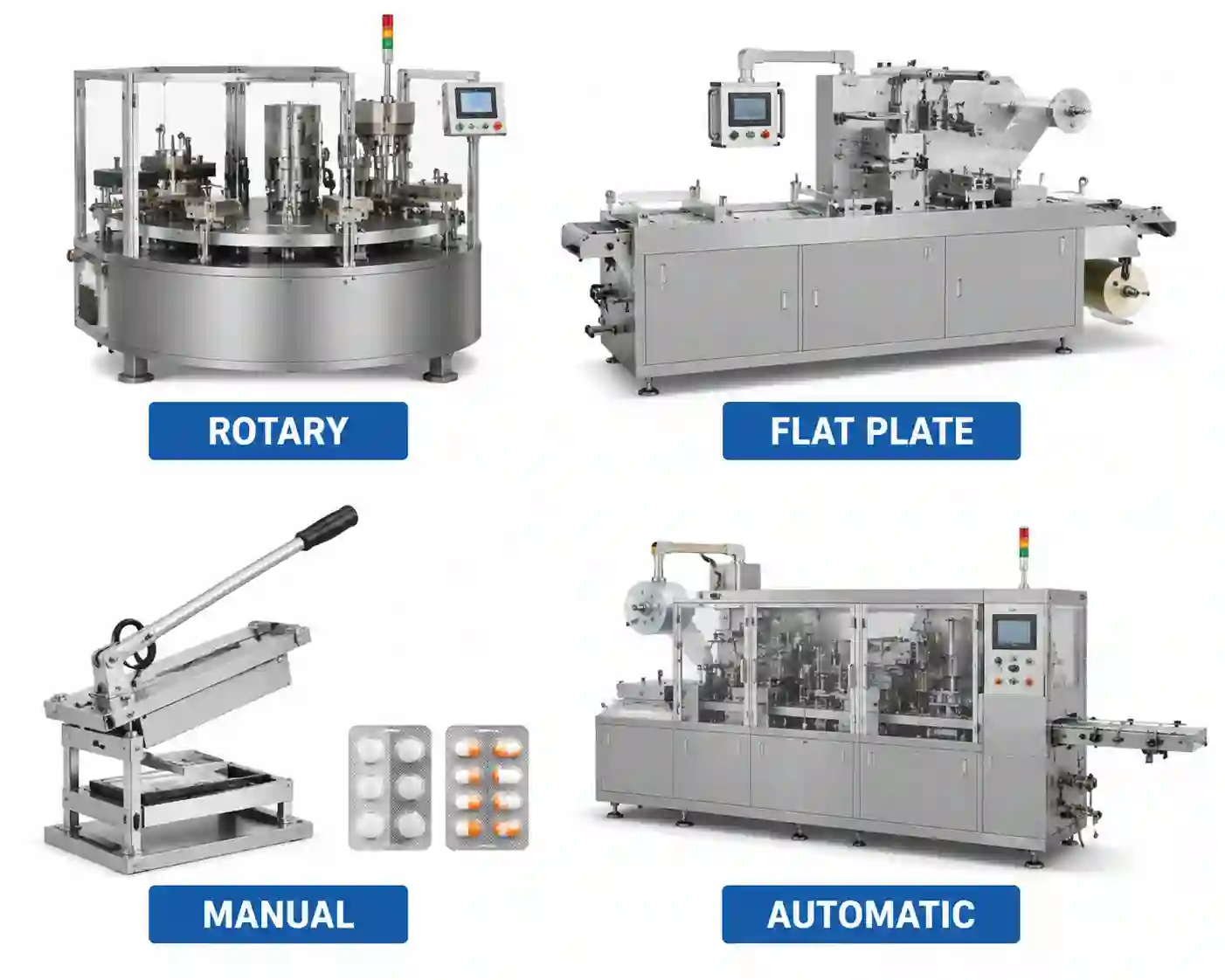
Rotary blistering machines use a continuously rotating drum for cavity forming, feeding, and sealing, enabling high-speed continuous operation.Pros: it is high throughput for large-scale production. meanwhile stable operation over long runs if properly maintained.
Cons: It is higher capital investment as it is automatic, but tooling precision and preventive maintenance are essential.
Engineer sayings: Buffer zones and inline sensors prevent misfeeds at high speeds. In my observation on a 15,000 tablets/hour line, even minor misalignment caused feed jamming. therefore we recommend lyou choose large-volume tablet or capsule lines when requiring consistent, high-speed operation.
2. Flat Plate Blister Machines – Precision & Flexibility
Plat plate blistering machines move blister sheets over a stationary forming plate in a stepwise fashion.Pros: it is highly precise forming —ideal for sensitive or irregular-shaped products. Flexibility for multiple SKUs and batch changes.
Cons: it is lower throughput compared to rotary machines. and stepwise motion requires precise alignment to avoid defects.
Engineer experience: In pilot lines, even a 0.2 mm misalignment caused cavity distortion. sest for products where shape integrity is critical. you can choose it if low- to medium-volume pharmaceutical production, R&D, or specialty products.
3. Manual Blister Machines – Small-Scale & Cost-Effective
Operators manually feed products and seal blisters using simple mechanical systems.Pros: it is low cost and minimal setup, and high flexibility for diverse SKUs.
Cons: since is manual, so it is labor-intensive and slower throughput. greater risk of human error in alignment and sealing in production.
Engineer suggestions: Best for R&D or small-batch runs and custom orders. it can ensure proper training to avoid frequent sealing issues.
4. Automatic Blister Machines – Fully Integrated & Efficient
Fully Automatic blister machines combine forming, feeding, sealing, and often inline inspection in a single automated system.Pros: it is high throughput with minimal manual intervention and supports integration with serialization, labeling, and quality inspection.
Cons: it is higher initial investment and requires trained operators and robust preventive maintenance plans.
Summary: Integration with cartoning and downstream lines is critical. Misalignment upstream can disrupt the whole line.
Comparative Overview for Your Reference
| Machine Type | Speed | Precision | Flexibility | Best Application |
|---|---|---|---|---|
| Rotary | High | Good | Medium | Large-volume tablet/capsule production |
| Flat Plate | Medium | High | High | Specialty, low-volume, sensitive products |
| Manual | Low | Medium | High | R&D, pilot batches, small-scale production |
| Automatic | High | High | Medium | High-volume integrated production lines |
Key Takeaways for Engineers
When choosing a blister machine, consider:
- Product type, shape, and sensitivity.
- Line speed vs. desired throughput.
- Integration with cartoning, inspection, and downstream lines.
- Operator skill level and maintenance capabilities.
FAQ
Q1: Which blister machine is best for high-speed pharmaceutical lines?
Rotary and fully automatic machines provide the throughput needed for large-scale tablet and capsule production.
Q2: When should flat plate machines be used?
For specialty products or sensitive tablets/capsules requiring high forming precision and minimal deformation.
Q3: Are manual machines still relevant?
Yes, for R&D, pilot runs, or low-volume production where automation is not cost-effective.
Ensure Your Blister Line Matches Your Product
Selecting the right machine is more than specs — it’s about matching product sensitivity, throughput, and line integration. Share your production requirements, and we can provide:
- Machine type recommendations
- Process optimization strategies
- Integration with cartoning and downstream systems
Internal Links for Further Reading
- Blister Packaging Materials Explained
- Blister Packaging Line Workflow & Cartoning Integration
- Why Blister Sealing Fails in Production