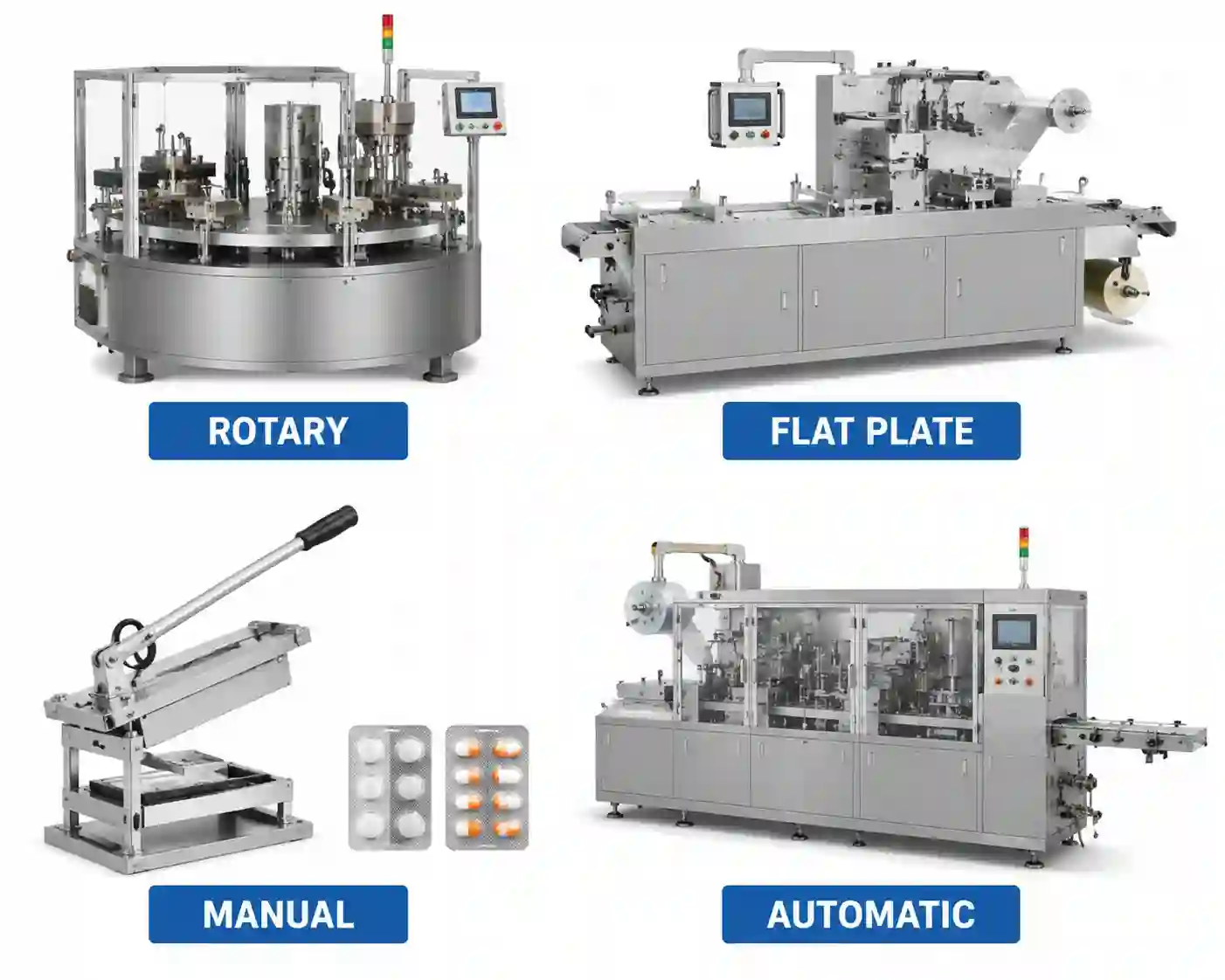
Manual vs. Fully Automatic Blister Packaging Machines: Which Is Right for Your Production Line?
Blister packaging has been as one of the popular packaging formats for pharmaceuticals, health supplements, food products, and small electronics, However, when selecting equipment, many buyers encounter a practical dilemma: Should i choose a *Manual Blister Packaging Machine* or a *Fully Automatic Blister Packaging Machine*?
It seems the distinction appears to be simply a matter of the "level of automation." in the first sight. the factors that truly drive the purchasing decision are often:
- Production capacity requirements
- Labor costs
- Packaging consistency
- Future scalability
- Mold changeover frequency
- Product specification complexity
We truly understanding that selecting the right machine can directly—and negatively—impact both production efficiency and operational costs down the line for pharmaceutical manufacturers, health supplement producers as well as for small brands just entering the market when your are currently expanding your operations.
What is a Manual Blister Packaging Machine?
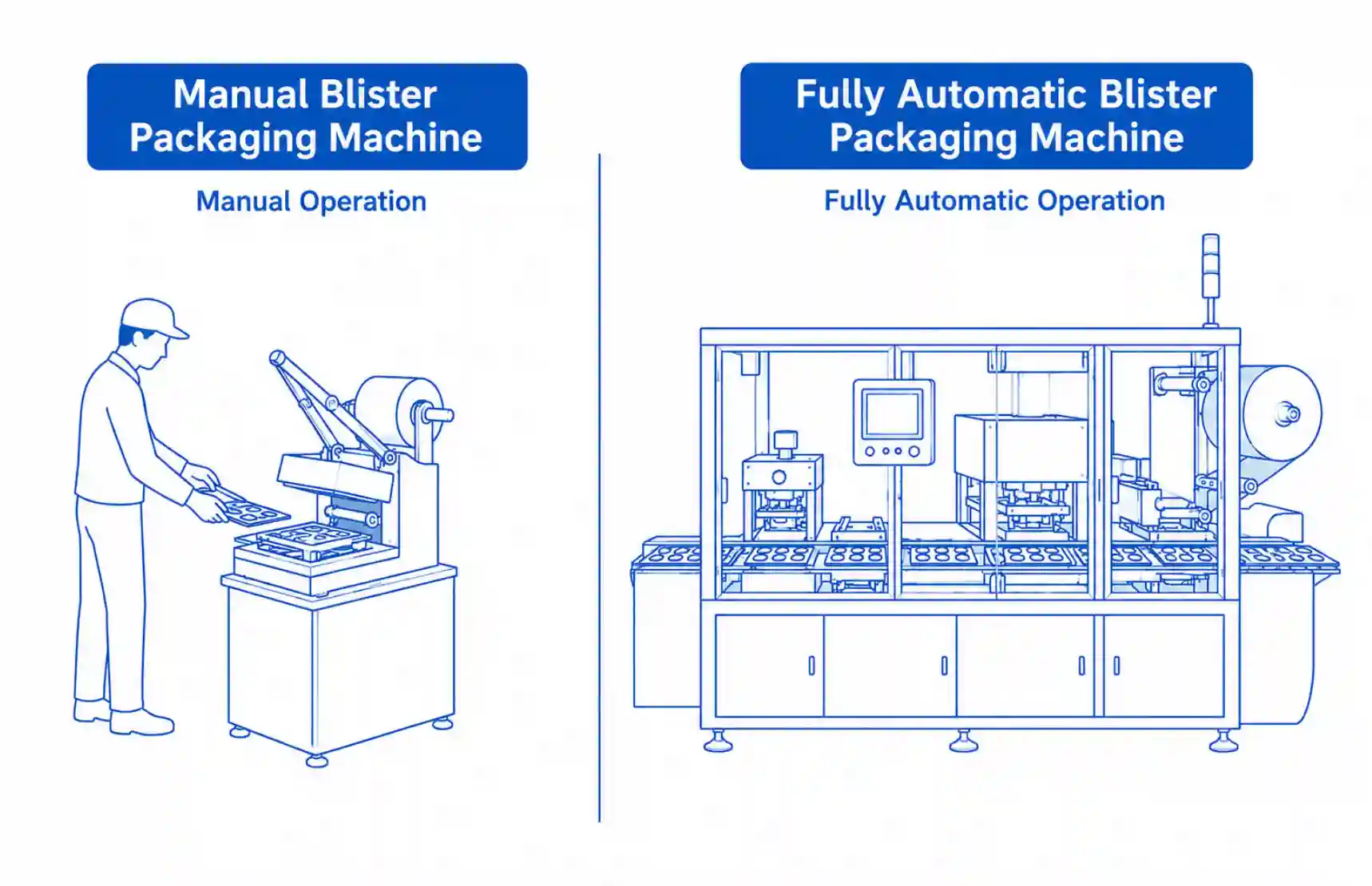
A manual blister packaging machine typically requires manual intervention to perform certain operations, such as:
- Loading materials
- Alignment
- Heat sealing
- Die-cutting
- Removing finished products
This type of equipment features a relatively simple structure and low investment costs, making it particularly suitable for:
- Small-batch production
- Laboratory testing
- New product prototyping
- Startup manufacturing facilities
- Packaging for multiple SKUs with low production volumes
Many small-scale pharmaceutical companies prioritize manual equipment during the initial market validation phase to mitigate investment risks.
What is an Automatic Blister Packaging Machine?
A fully automatic blister packaging machine utilizes a PLC control system to execute the following functions:
- Automatic feeding
- Automatic forming
- Automatic heat sealing
- Automatic batch number printing
- Automatic punching/cutting
- Automatic waste recovery
The entire production process operates continuously, making it suitable for:
- Medium-to-large-scale pharmaceutical manufacturing facilities
- High-speed, continuous production operations
- GMP-compliant production environments
- Large-volume order fulfillment
As labor costs continue to rise, an increasing number of manufacturing plants are upgrading from semi-automatic to fully automatic production lines.
Manual vs. Automatic Blister Packaging Machines: Key Differences
1. Production Efficiency
This constitutes the most significant difference between the two.
| Comparison Item | Manual Blister Packaging Machine | Automatic Blister Packaging Machine |
|---|---|---|
| Production Efficiency | Lower production speed, usually dependent on operator experience | Capable of continuous high-speed production |
| Operating Method | Intermittent manual operation | Fully automatic continuous operation |
| Production Stability | More affected by manual operation | Stable long-term operation with reduced downtime |
| Suitable Applications | Small orders, customized packaging, R&D testing | Mass production, continuous production, export orders |
| Labor Dependency | Higher | Lower |
| Delivery Stability | Production rhythm may fluctuate | More suitable for stable delivery schedules |
| Typical Industries | Small factories, laboratories, product testing | Pharmaceutical factories, nutraceutical plants, large-scale production lines |
2. Labor Costs
Many companies initially focus solely on the purchase price of equipment; however, from a long-term perspective: Labor costs are the primary driving force behind automation upgrades.
For manual equipment: Requires greater human involvement. In terms of long-term operations:
- Training costs are higher.
- Personnel turnover impacts production stability.
- Packaging consistency is prone to fluctuation.
For Fully automated equipment:Although the upfront investment is higher, it can significantly reduce long-term labor requirements. Particularly in Western markets—where labor costs are on the rise—the Return on Investment (ROI) for fully automated equipment is typically much more pronounced.
3. Packaging Consistency
In the context of pharmaceutical packaging, consistency impacts not only the visual appearance but also critical factors such as seal integrity, moisture resistance, product protection, and GMP compliance. Specifically, manual equipment is prone to quality issues stemming from human error—such as inconsistent heat-sealing pressure, alignment deviations, and uneven edges—whereas fully automated equipment offers more stable parameter control, making it significantly easier to maintain consistent quality, particularly in applications involving PVC/Alu, Alu-Alu, and high-barrier packaging materials.
5. Mold Changeover and Product Flexibility
For health supplement manufacturing facilities that requring switch SKUs frequently —such as those handling capsules of varying specifications, tablets of different sizes, or multiple packaging formats—manual equipment offers greater flexibility when transitioning between small batches and diverse product variants.While fully automated equipment boasts higher efficiency, switching between complex products may necessitate mold changes, parameter adjustments, and recalibration. Consequently, facilities with a high volume of SKUs typically prioritize the efficiency of equipment mold changeovers.
Which Blister Packaging Machine Is Right for You?
In reality, there is no single machine that is "absolutely better" than the others. mostly depends on your specific production stage.
If you fall into any of the following categories, Then a Manual Blister Packaging Machine is often the more prudent choice.
- A startup facility
- Small-batch production
- An R&D laboratory
- The product testing phase
- Working with a limited budget
If your situations are below listed, then Then a fully automatic blister packaging machine is typically a more worthwhile investment.
- Have a steady stream of orders
- Need to increase production capacity
- Target export markets
- Must comply with GMP standards
- Wish to reduce long-term labor costs
FAQ
Q1: Is a manual blister packaging machine suitable for the pharmaceutical industry?
A: It is suitable for small-batch production, laboratory use, and R&D testing.
However, for large-scale GMP production, fully automatic equipment is generally recommended.
Q2: Is a fully automatic blister packaging machine always the better choice?
A: Not necessarily. If order volumes are small, fully automatic equipment may not provide a quick return on investment.
Q3: Can a blister packaging machine accommodate Alu-Alu packaging?
Some machines do support this, but specific parameters must be verified:
- Forming pressure
- Forming depth
- Material compatibility
Cold-form aluminum, in particular, places higher demands on the equipment.