Flat-Plate vs. Rotary Blister Machines: Which One Fits Your Production Volume?
In the pharmaceutical packaging industry, efficiency is currency. When selecting a blister packing machine for a new production line, procurement managers often face a critical dilemma: Should you invest in a flexible Flat-Plate machine or upgrade to a high-speed Rotary (Roller) machine?
Making the wrong choice can lead to two painful scenarios: either you bottleneck your production with a machine that’s too slow, or you drain your budget on high-capacity equipment that sits idle during product changeovers.
At Wenzhou Kxite Machinery, we provide comprehensive solutions for both technologies. Whether you need the versatility of a Flat-Plate Blister Machine or the mass-production capability of a Rotary Blister Machine, we help you make the right choice based on your production volume.
1. The Core Difference: Intermittent vs. Continuous Motion
To understand the output, you must first understand the mechanics.
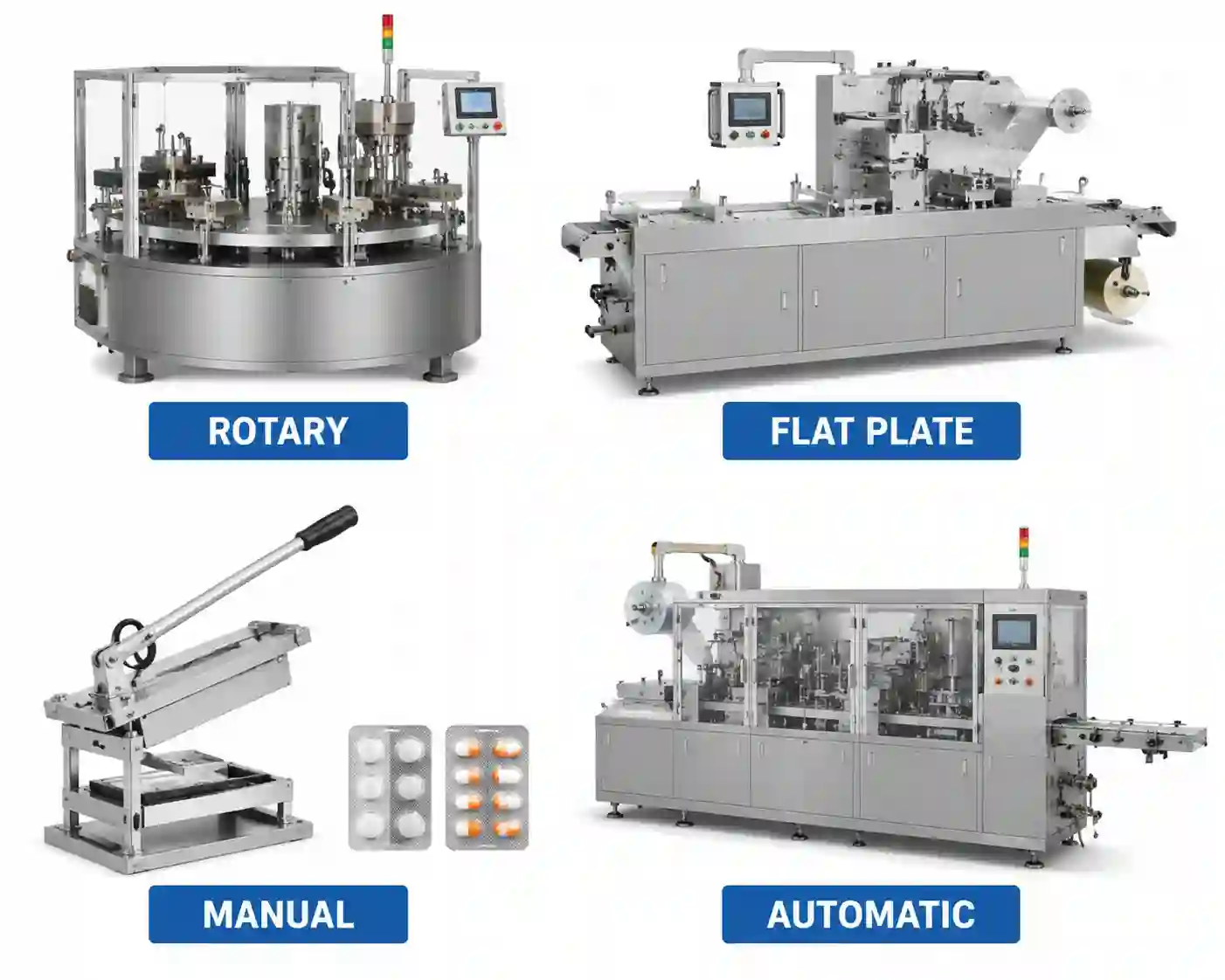
Flat-Plate Blister Machines (Intermittent Motion)
Think of this like a stamper. The machine pulls the packaging material (PVC/Alu), stops momentarily, presses the heated plates down to form the blisters, and then moves forward to the sealing station.
- Mechanism: Plate-type forming and sealing.
- Key Characteristic: Intermittent stop-and-go motion.
- Ideal For: Frequent changeovers and smaller batch sizes.
Rotary Blister Machines (Continuous Motion)
Think of this like a rolling pin. The material moves continuously across a rotating cylindrical mold. The forming and sealing happen in a fluid, non-stop motion.
- Mechanism: Roller-type forming and sealing.
- Key Characteristic: Continuous high-speed motion.
- Ideal For: High-volume mass production.
2. Flat-Plate Machines: The Flexible All-Rounder
Flat-plate machines are the industry standard for small to medium-sized batches. Their biggest advantage is versatility.
Why choose Flat-Plate?
- Better for Alu-Alu (Cold Form): Because the plates can apply high pressure for a longer dwell time during the "stop" phase, flat-plate machines generally produce sharper, deeper cavities for cold-forming aluminum (Alu-Alu) packaging.
- Lower Tooling Cost: The molds are flat and compact, making them significantly cheaper to manufacture and replace than precision-engineered cylindrical rollers.
- Faster Changeover: If your factory produces 10 different drugs in short runs, the quick mold changeover of a flat-plate machine saves valuable time.
The Downside: The stop-and-go motion limits the maximum speed. Most flat-plate machines operate at lower speeds compared to rotary models.
3. Rotary Blister Machines: The Speed Kings
If your goal is mass production, the Roller type blister machine advantages become undeniable. These machines are engineered for maximum throughput.
Why choose Rotary?
- Unmatched Speed: By utilizing continuous rotary motion and advanced servo drive systems, these machines can achieve remarkably high cutting frequencies, often reaching 180 to 240 cuts per minute. This is significantly faster than standard flat-plate models.
- Space Efficiency: Despite their high output, rotary machines often have a compact footprint relative to their production capacity.
- Consistent Sealing: The continuous rolling seal minimizes air bubbles and ensures a uniform grid seal, especially for Alu-PVC packs.
The Downside: The curved, cylindrical molds are more expensive to produce. Therefore, this machine is best suited for dedicated lines producing large volumes of a single product.
4. Comparison Table: Flat-Plate vs. Rotary
Here is a side-by-side high speed blister packaging machine comparison to visualize the differences:
| Feature | Flat-Plate Machine | Rotary Machine |
|---|---|---|
| Forming Principle | Intermittent (Plate Press) | Continuous (Rotary Roller) |
| Max. Speed | Standard Speed | High Speed (up to 240 cuts/min) |
| Best For Materials | Alu-Alu (Cold Form) & Alu-PVC | Primarily Alu-PVC (High Speed) |
| Mold Cost | Low ($) | High ($$$) |
| Changeover Time | Fast | Slower (Requires precision alignment) |
| Recommended Volume | Small to Medium Batches | Mass Production |
5. Which One Should You Buy?
Choose the Flat-Plate Machine if:
- You run many SKUs: You change products frequently (e.g., multiple times a week).
- You need Alu-Alu: You require deep-draw cold-forming for moisture-sensitive drugs.
- Budget is a priority: You need a lower initial capital investment.
Choose the Rotary Machine if:
- Volume is King: You have large orders for specific standard drugs (e.g., Capsules, Tablets).
- Efficiency Matters: You want to reduce the "cost per pack" by maximizing speed.
- Space is limited: You need the output of multiple flat-plate machines but only have space for one high-speed unit.
Conclusion
Both technologies have their place in a modern pharmaceutical facility. The Flat-Plate machine offers flexibility for diverse product portfolios, while the Rotary machine delivers the raw power needed for market dominance.
At Wenzhou Kxite Machinery Technology Co., Ltd., we understand that every production line is unique. We offer advanced solutions for both flat-plate and rotary applications. Our engineering team can tailor a solution to your facility's layout and GMP requirements.
Still unsure which model fits your forecast?
Contact our engineering team today for a free production capacity calculation and a customized proposal.