What is a Tablet Counting Machine (And Why Accuracy Fails in Real Production)
Introduction: Counting Looks Simple — Until You Run a Line
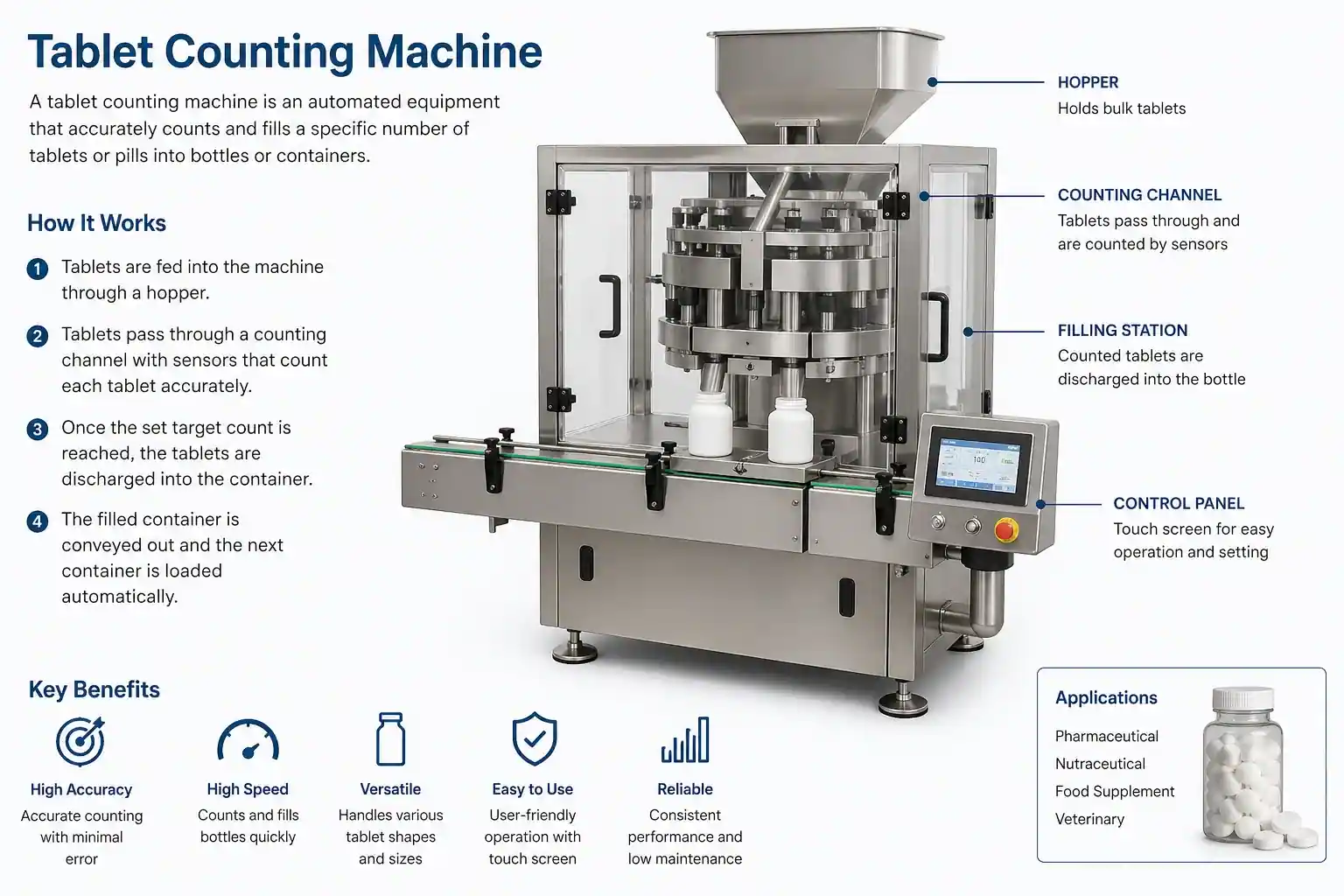
A tablet counting machine is often described as a straightforward piece of equipment: count tablets or capsules and fill them into bottles.
That description is not wrong — but it is incomplete. In actual pharmaceutical and nutraceutical production, counting is one of those processes that looks stable during testing, but becomes harder to control once the line runs continuously.
Many manufacturers only realize this after installation, when small deviations begin to appear over time. This article explains what a tablet counting machine does, and more importantly, why counting accuracy can become unstable in real production conditions.
What is a Tablet Counting Machine?
A tablet counting machine (also used for capsules and softgels) is a core unit in a solid dosage packaging line. Its role is to:
- Count a defined number of products
- Fill them into bottles or containers
- Work in sync with downstream equipment such as capping and sealing
From a process perspective, it sits between product feeding and container sealing, making it a key control point for both output consistency and compliance. This is a widely accepted
configuration in pharmaceutical bottling lines.
Why Counting Accuracy Becomes Unstable in Production
Under controlled conditions, counting systems can perform consistently. In production, however, several variables interact at the same time. Below are the most commonly observed factors affecting tablet counting accuracy.
1. Dust Accumulation Affects Detection
Tablet and capsule handling inevitably generates fine dust. This is especially noticeable with uncoated or brittle products.
Over time, dust can:
- Interfere with optical detection
- Reduce signal clarity
- Build up around critical components
This effect is widely recognized in production environments, especially for photoelectric-based counting systems. In practice, accuracy issues often do not appear immediately, but after a period of continuous operation.
2. Product Behavior Changes at Higher Speeds
Increasing line speed changes how products move. Instead of flowing evenly, tablets may:
- Bounce or overlap
- Enter detection zones irregularly
- Pass too quickly for stable detection
This is a common observation across different counting technologies. For this reason, many engineers evaluate performance based on stable operating speed, rather than maximum rated speed.
3. Feeding Stability Matters as Much as Counting
Counting accuracy does not depend only on sensors. If product feeding is inconsistent:
- Distribution across channels becomes uneven
- Flow into the counting zone fluctuates
- Detection conditions change continuously
In real production, feeding design is often a deciding factor in overall performance.
4. Static Electricity Can Disturb Product Flow
Static electricity is not always considered during equipment selection, but it can affect performance, especially in dry environments. Possible effects include:
- Products sticking together
- Irregular falling patterns
- Inconsistent spacing during counting
These issues are typically observed during operation rather than testing.
Different Counting Technologies — Practical Differences
Different tablet counting machine types respond differently to real production conditions.
Electronic (Photoelectric) Counting
- Based on optical sensors
- Flexible and widely used
- Performance depends on product flow and cleanliness
Suitable for general applications with controlled conditions.
Slat Counting
- Uses mechanical positioning
- Less sensitive to dust
- Limited flexibility for product variation
Often selected where stability is prioritized over flexibility.
Vision-Based Counting
- Uses image recognition
- Can distinguish product shape and presence
- More complex in setup and maintenance
Applied in cases where detection requirements are stricter.
Real Production Pattern: When Issues Start to Appear
In many installations, counting accuracy follows a similar pattern:
- Initial operation is stable
- Gradual accumulation of dust and minor deviations
- Feeding conditions begin to shift
- Small counting inconsistencies appear
This pattern is commonly reported in production environments. Because of this, long-term consistency is often used as a more practical evaluation standard than short-term testing results.
Common Misunderstandings
“Accuracy is only determined by the machine”
In practice, accuracy depends on:
- Product characteristics
- Environmental conditions
- Equipment setup and maintenance
“Test performance equals production performance”
Testing is controlled.
Production introduces variability.
This difference is widely acknowledged in equipment validation processes.
“Higher speed always improves efficiency”
Higher speed can increase output, but may also introduce instability.
Balancing speed and consistency is a common engineering decision.
How Accuracy Is Typically Improved
Improving counting performance usually involves multiple aspects:
- Managing dust through design or maintenance
- Stabilizing product feeding
- Controlling environmental factors such as humidity
- Selecting counting technology based on product characteristics
These are standard considerations during line design and optimization.
Typical Line Configuration
A standard tablet and capsule bottling line may include:
| Module | Equipment | Function |
|---|---|---|
| Bottle Handling | Bottle Unscrambler | Bottle orientation and feeding |
| Counting | Tablet / Capsule Counting Machine | Product counting and filling |
| Protection | Desiccant Inserter | Moisture control |
| Filling Assist | Cotton Inserter (optional) | Product stabilization |
| Sealing | Induction Sealing Machine | Container sealing |
| Closing | Capping Machine | Bottle closure |
| Identification | Labeling Machine | Product labeling |
This configuration reflects common industry setups, though actual layouts vary by application.
Applications
Tablet counting machines are commonly used in:
- Pharmaceutical manufacturing
- Nutraceutical production
- Health supplement packaging
FAQ
Q1: What affects tablet counting accuracy the most?
A: Typically product behavior, dust, and feeding stability. These factors are widely observed in production environments.
Q2: Why do issues appear after the machine has been running for some time?
A: Because conditions such as dust accumulation and flow consistency change during continuous operation (经验总结).
Q3: Is one type of counting technology always better?
A: No. Selection depends on product characteristics and production requirements.