How to Choose a Blister Packaging Machine
Why Choosing the Right Machine Matters
Choosing a blister packaging machine is not just about speed or price. In real projects, many buyers end up selecting machines that don’t truly match their product or packaging requirements — which often leads to inefficiency, material waste, or production issues later on.
Instead of starting from machine specifications, a more reliable approach is to begin with your product, packaging material, and production needs. This guide walks you through the key factors that actually determine the right machine.
1. Start with Your Product Type
Every selection starts with the product. Blister packaging machines are commonly used for:
- Tablets and capsules
- Food items such as chocolate or candy
- Small consumer goods and cosmetic products
Different products require different levels of protection, shaping precision, and packaging structure.
For example:
For pharmaceutical applications, a pharmacy blister packaging machine is typically required to ensure consistent quality and compliance with packaging standards.Therefore, Define your product characteristics first — machine selection comes after.
2. Choose the Right Packaging Material
In many real-world cases, packaging material has a bigger impact on machine selection than expected. so it is critical step. Common blister materials include:
- PVC / PET (transparent, cost-effective, widely used)
- Aluminum foil used in ALU-PVC blister packaging, which provides higher barrier protection against moisture and light
General guidance:
- Transparent materials are often chosen for product visibility and lower cost
- Aluminum-based materials are used when protection is the priority
In most cases:
- Thermoforming is used for plastic materials (PVC/PET)
- Cold forming is more suitable for aluminum-based packaging
Quick Selection Guide
This table can help you quickly narrow down your options before going deeper.| Your Situation | Recommended Option |
|---|---|
| Moisture-sensitive products | Cold forming blister machine |
| Cost-sensitive packaging | Thermoforming machine |
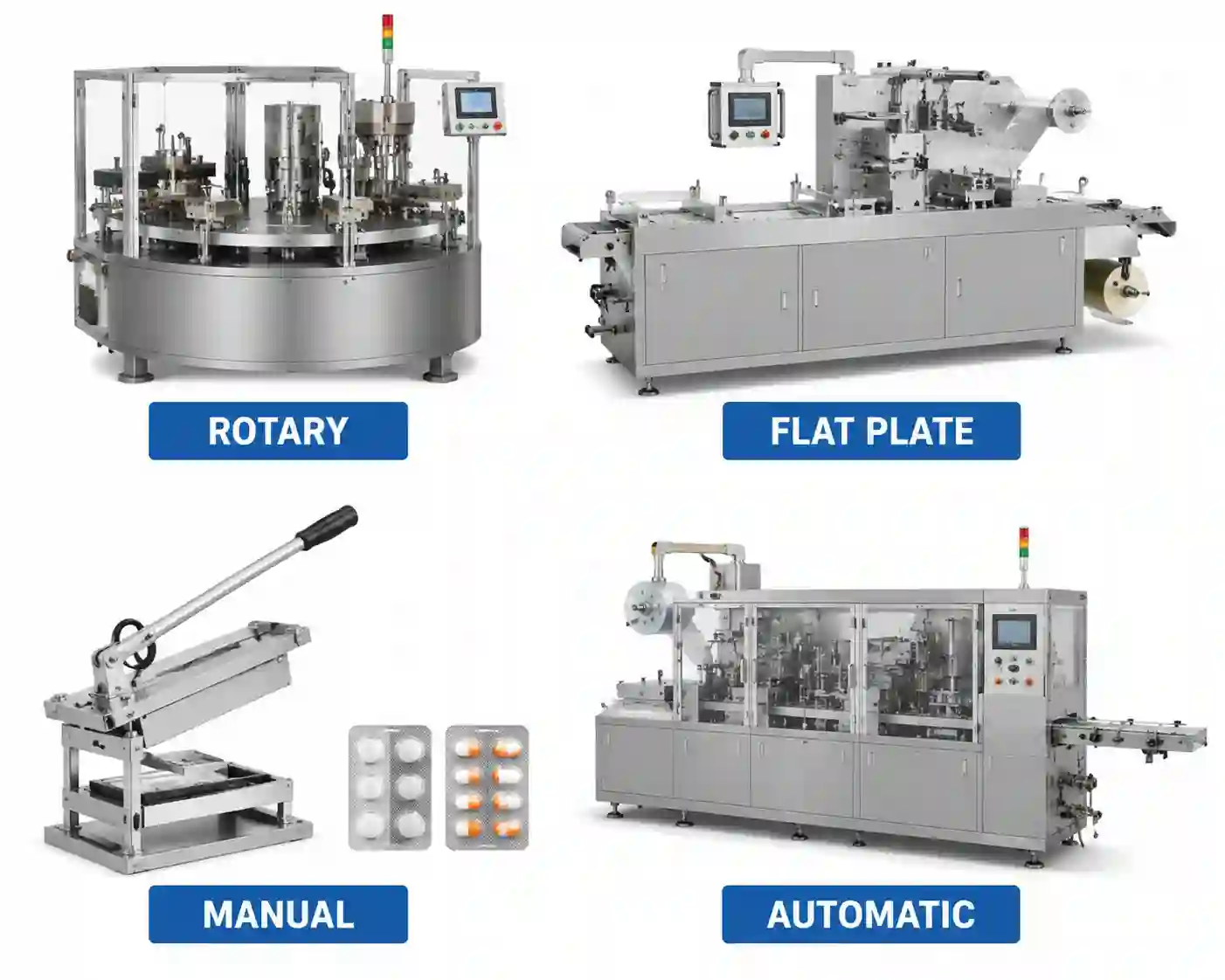
| Small batch production | Semi-automatic machine |
| High-volume production | Fully automatic machine |
3. Determine Your Production Capacity
Production capacity directly affects the type of machine you should consider. Ask yourself first:
- What is my expected output per hour or per day?
- Is my production continuous or batch-based?
General guidance:
- Lower output → semi-automatic or compact machines
- Higher output → fully automatic blister packaging machines
Remember: Choosing excessive capacity often increases investment without improving real efficiency.
4. Understand the Level of Automation
Blister packaging machines are typically available in:
- Semi-automatic configurations
- Fully automatic configurations
Fully automatic machines are suitable for large-scale, stable production environments.
Semi-automatic machines are often preferred for smaller production lines or when flexibility is required.
Your decision should consider:
- Labor cost
- Production stability
- Budget constraints
5. Consider Mold Flexibility and Changeover
This is one of the most commonly overlooked factors. In real on-site practice, many buyers only focus on initial production needs — but later face challenges when switching products.
You should evaluate:
- How quickly molds can be changed
- Whether the machine supports multiple product sizes
- Downtime during changeover
This is especially important for:
- Contract manufacturers
- Businesses handling multiple SKUs
In actual production, many buyers initially focus on machine speed. However, mismatching the packaging material with the machine type often leads to more serious problems — including sealing defects, unstable output, and increased material waste. so in acturally cases, material compatibility matters more than speed.
6. Common Mistakes to Avoid
Based on typical industry scenarios, these are common issues as below:
- Choosing a lower-cost machine that cannot support your packaging material
- Selecting excessive capacity that increases cost without real efficiency gains
- Ignoring mold changeover time, leading to production delays
- Not considering future product variations, resulting in additional investment
In a lot situations, the wrong initial choice leads to higher long-term costs.
7. A Simple Selection Logic
If you're unsure where to start, this simplified logic can help you on final decision:
- If your product requires high barrier protection → consider aluminum-based blister + cold forming
- If cost and visibility are priorities → thermoforming is generally more suitable
- If production volume is high → consider a fully automatic machine
- If flexibility is important → prioritize mold changeover capability
Finally, Focus on Fit, Not Just Specifications
Choosing a blister packaging machine is not about finding the “most advanced” machine, but the one that best fits your product and production requirements.
In many cases, production issues are not caused by machine quality, but by mismatched selection at the beginning.
Still Not sure which blister packaging machine fits your application?
- Your product type
- Packaging material (if available)
- Expected output
Our team, as an experienced blister packing manufacturer, will recommend a suitable machine configuration based on your actual production needs.